The Management Myth

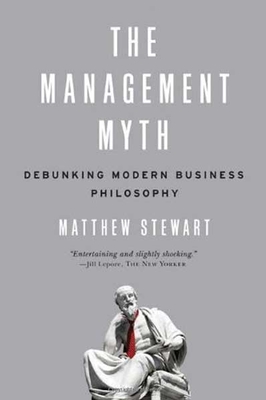
Cover of The Management Myth The management consulting business has always been a bit of a mystery to me. Something just doesn't add up. Matthew Stewart just wrote a book about this called the Management Myth, where he chronicles his time as a management consultant at a major firm. I think these two quotes from the book sum up my confusion nicely.

Can you think of anything less improbable than taking the world's most successful firms, leaders in their businesses, and hiring people just fresh out of school and telling them how to run their businesses, and they are willing to pay millions of dollars for their advice?

With my overpriced advisory services and profligate spending on luxury travel, I was a grossly inefficient efficiency expert, a parody of economic virtue.

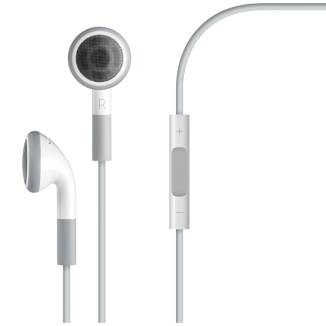
Apple Earphone

Apple_earphones_with_remote_and_micOver the past six months I've cycled through at least six pairs of earphones; I lost one or two, most of them broke. Most were pretty inexpensive but I did spend about $80 on the Bose in ear headphones. The sound was awesome but they're very delicate and terrible for exercise.

I just picked up a pair of Apple's earphones that include volume control and a microphone that can be used with your cell phone. These earphones are by FAR the best out there:

Sound is awesome

  • They feel sturdy and seem less likely to break
  • The microphone is really convenient
  • Very comfortable and they don't fall out of my ears no matter how fast I run
  • They don't have rubber buds that are easy to lose and never seem to fit right

They're only $30 Once again, Apple wins with a great product.

Why Chrome will be free

Rumor has it that Google's soon to be released OS will be free. I was thinking about why they would give out a very valuable product to users at no cost; surely they could price Microsoft out of some market share without going to zero?

 A couple thoughts:
  • 80% of online ad spending goes to Google
  • The vast majority of ad spend still happens offline
  • Cheaper operating systems will result in cheaper PCs
  • Cheaper PCs will result in more computer/internet use
  • More internet use leads to more attention online
  • More attention online leads to more ad spending online
  • 80% of online ad spending goes to Google
 That's why Chrome will be free; it's an investment that will shift attention online faster than the current pace.

Public Schools

Would you invest in a company that:

  • Pays no attention to its competition
  • Rejects change
  • Doesn't allow managers to reward high performing employees
  • Pays employees less than they deserve
  • Doesn't allow managers to phase out low performing employees
  • Has little or no long term vision for success or strategic plan to get them there
  • Doesn't hold people accountable for short or long term success metrics
Neither would I.

Unfortunately, I'm not describing a stock, I'm describing our public schools.

I have a few close friends that are teachers.  I also spent 13 years sitting in public school classrooms, so I'm moderately qualified to write about this problem.

For the most part, the friends I have that teach in public schools seem to do it for the right reasons and they seem to be pretty good at what they do.  And there's no doubt that teaching in public schools can be extremely challenging and I sincerely admire the field they've chosen.

But it also seems that all of my friends that teach lack a high level understanding of what makes an organization super successful.  Things like ROI, six sigma, remove the bottom 20%, change management and many other fundamentals of a competitive industry are completely foreign to them.  They fundamentally don't understand business and its powerful forces and consequences.  My teacher friends joke my business friends that we all work in a big building on Wall Street.  "Isn't that what all business people do?"  In short, they have no idea what goes inside the walls of a competitive business.  Why would they?  Most have never spent any time inside of one.

Further, in their own profession they're simply not subject to the forces (profits, competition, lightning fast change) that drive businesspeople and force them succeed or die.

As a result, I would argue, our schools aren't moving forward.

In a competitive industry, if an employee doesn't add incremental value to the organization each quarter, it's only a few quarters before the employee is asked to leave.  If the company doesn't add incremental value each quarter, it'll eventually suffer a similar fate.

In public schools, if a teacher doesn't add incremental value to the school each school year, there are zero consequences.  If the school doesn't add incremental value each school year, there are zero consequences.

To me, this is the essence of the problem.  The former is a formula for success, the latter a formula for mediocrity.

I recognize that this is an extremely thorny issue and there are longstanding institutionalized competing interests that make fast change all but impossible.  And there are no easy answers.

But when considering issues like teachers' pay, tenure, charter schools, and school choice my thinking is guided by the difference between a formula for success and a formula for failure.  When i vote on these issues, I cast the vote that I think will get us further away from forced mediocrity.
Ignore Everybody

I ordered Hugh Macleod's new book Ignore Everybody from Amazon and read it cover to cover in one sitting after getting home from work tonight.  Great book.  There were a lot of really cool ideas and observations that I felt I could really relate to.  Some of his lines about New York were right on. ..

Anyway, here are the lines I liked the most and I hope I don't forget.

  • ...most team members are far more concerned with the power relationships going on inside their immediate professional circle than with what may be actually interesting and useful to the customer.
  • Everybody has their own private Mount Everest they were put on this earth to climb.  You may never reach the summit; for that you will be forgiven.  But if you don’t make at least one serious attempt to get above the snow line, years later you will find yourself lying on your deathbed and all you will feel is emptiness.
  • Meeting a person who wrote a masterpiece on the back of a deli menu would not surprise me.  Meeting a person who wrote a masterpiece with a silver Cartier fountain pen on a antique writing table in an airy SoHo loft would seriously surprise me.
  • Art suffers the moment people start paying for it.
  • Never try to sell a meteor to a Dinosaur.  It wastes your time and annoys the Dinosaur.
  • Quality isn’t Job One.  Being totally f***ing amazing is Job One.
  • It’s hard to sell if nobody has bought in.
  • Stay ahead of the culture by creating the culture.
  • Nobody moves to Ne w York in order to survive.  Of course that’s what most of them end up doing.
  • A lot of people in business say they have twenty years experience, when in fact they only have one year’s experience, repeated twenty times.
  • The biggest mistake young people make is underestimating how competitive the world is out there.
  • "I don’t need a lot to be happy," said Eric.  "Just enough to pay the rent and enjoy a beer with my friends.  I don't think that’s asking for too much."  Eric was obviously a deranged lunatic.
  • Work hard.  Keep at it.  Live simply and quietly.  Remain humble.  Stay positive.  Create your own luck.  Be nice.  Be polite.

Healthcare Costs

Steven Burd, the CEO of Safeway, Inc. had a really interesting column in the Wall Street Journal a couple weeks ago outlining his company’s approach to reducing healthcare costs.  He included some fascinating statistics that I thought were worth pointing out:
  • Healthcare spending will represent 18% of GDP in 2009
  • 70% of all healthcare costs are confined to four chronic conditions (cardiovascular disease, obesity, diabetes and cancer)
  • Most instances of the above conditions are preventable
Safeway’s approach to reducing costs is simple.  They reward employees financially for taking preventative measures based on the four chronic conditions listed above.  If they pass a baseline test on each of the four factors, they can save as much as $780 and $1560 for families.  

Based on the work I’ve done in this area, it seems that it’s nearly impossible to generate reliable correlations between investments in promoting healthy behaviors and reduced healthcare costs for companies.  But I think it’s nearly impossible to doubt Safeway’s investment is a long term win employees, the company and the public.

Textbooks

Not including a two-year stint in preschool, I have attended school for 20 years -- kindergarten through graduate school. In that time, the content and tempo of the majority of my classes had been driven by big, expensive, boring textbooks. I really noticed this when I was in graduate school and paying for the classes and books myself. What value was the professor adding I thought? Why couldn't I just buy a bunch of business textbooks, force myself to complete the problems, save myself $80,000 and call myself an M.B.A.? For this reason, I was thrilled to read an energetic rant by Seth Godin yesterday on why he believes assigning a textbook to a college class is the equivalent of academic malpractice.

I agree.

Let's consider the value that the institution is adding to a student's education when a class is dictated by a textbook.

  1. A schedule (usually the chapters in the textbook are spread out over the course of the semester and matched to individual weeks in some logical order; occasionally this order isn't the same as the order of the chapters, so there's some thinking going on there...)
  2. Motivation (in a classroom environment a student might be reluctant to disappoint his or her classmates/professor)
  3. Classroom discussion (debate, real world examples, etc.)

Am I missing anything?

The schedule is worthless and the classroom discussion can be replaced for free by discussion forums on thousands of different blogs. So all the institution is really providing is an environment where a student feels some pressure to keep up.

Not much different than kindergarten.

Note: What I've described here represents a majority of the classes I took in college and graduate school. There were several classes where the professor ditched the textbook and brought remarkable value to the class through a combination of his or her own published work, passion, real world experience and highly engaging discussion. I hope Seth's post inspires more educators to do the same.